
千方百计爱上你
China’s ‘Xuelong 2’ begins first ice station survey in central Arctic Ocean_我的网站

A | Taipei, Oct 10 (UNI) Taiwan on Monday marked the "Double Ten" or 10 October, the self-ruled island's national day.
The annual celebration is especially significant this year -- tensions with Beijing, which claims Taiwan as its territory, are at an all-time high, reports BBC.
China's leader Xi Jinping, who has been particularly vocal about "re-unification", is set to get a third term at a historic Communist Party meeting next week.
Ironically, 10 October has nothing to do with Taiwan or any moment in its history. It, in fact, marks the day in 1911 when an uprising began in Wuchang in central China that eventually led to the collapse of the last imperial dynasty -- and the establishment of the Republic of China.
So why is Taiwan celebrating the day? Because the island's official name is still The Republic of China on Taiwan. The flags flying across Taipei today are still of the white star on a blue and red background.
It is a peculiar legacy of the Chinese civil war. In 1949, the defeated nationalist regime of Chiang Kai-shek fled across the Taiwan strait to Taipei. For decades Chiang held Taiwan in an iron grip, while continuing to proclaim his regime "the true democratic government of Free China", the BBC reported.
Today all of this seems slightly absurd -- and for so many Taiwanese, especially the younger generation, it is.
Opinion polls this year suggest that 70to 80 per cent of people here now consider themselves "Taiwanese". That is a significant increase from a decade ago, when around half the population still said they were "Chinese".
This trend has not gone unnoticed in Beijing, and it is retaliating, the report said.
Around half of the island's population now supports formal independence, even under threat of attack from China. A poll last year showed 75 per cent of Taiwanese say they would fight a Chinese invasion.
UNI MR。
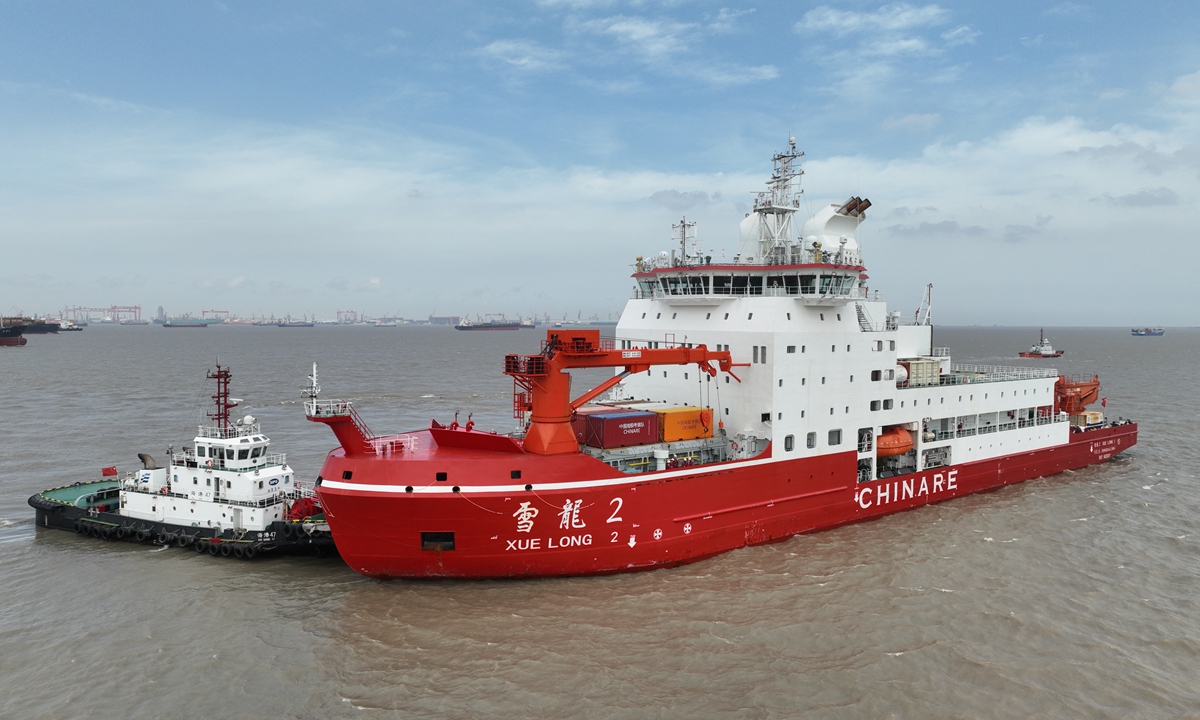
After completing the first stage of comprehensive ocean station surveys on Friday, Xuelong 2 sailed toward higher latitudes and selected a large, relatively flat piece of sea ice about 1.5 meters thick in a densely packed ice zone for its first ice station.
According to Lin Long, captain of the Xuelong 2 sea ice team, the ice station survey conducted by the vessel during this voyage will include six short-term ice stations and one long-term ice station, the Xinhua News Agency reported Sunday.
More than 20 types of scientific operations will be carried out, including the deployment of expendable ice-based buoys, snow and ice-core sampling, under-ice water sampling, sea-ice remote sensing, atmospheric profiling and under-ice oceanographic observations.
Lan Musheng, assistant to the chief scientist of the expedition, said the researchers will comprehensively monitor changes in parameters related to the atmosphere, sea ice, upper ocean and ecological processes beneath the ice as the sea ice melts.
The observations will provide scientific data for studying the rapid changes in Arctic sea ice, the mechanisms behind those changes and the evolution of Arctic ecosystems.
The ice station work is part of China's 16th Arctic Ocean scientific expedition, which was organized by the Ministry of Natural Resources. The expedition set sail from Dalian, Northeast China's Liaoning Province on July 3.
The mission is being carried out by four vessels - Xuelong, Xuelong 2, Jidi and Tansuo-3 - and is expected to be completed in early October.
The expedition is focusing on comprehensive surveys of sea ice, hydrology, biology, ecology and the atmospheric environment in key areas of the Arctic Ocean.
The two icebreakers Xuelong and Xuelong 2 will work together on the ice station surveys. Xuelong completed surveys at 12 ice stations on Friday.
Lin said the ice station locations planned for Xuelong 2 will work in coordination with those of Xuelong to form an observation array.
The arrangement will allow researchers to more deeply investigate the interactions among the atmosphere, sea ice and ocean in the central Arctic Ocean amid rapid environmental changes, as well as their coupling effects with the ecosystem.
The expedition is being conducted against a backdrop of rapid changes in the Arctic environment.
When the mission was launched in July, expedition leader Wang Jinhui said that global warming was driving rapid and profound changes in the Arctic natural environment, with trends such as sea-ice melting intensifying.
The expedition is therefore designed not only to monitor environmental changes but also to investigate frontier scientific questions, including the dynamic evolution of the oceanic crust.
Working on sea ice also presents significant safety challenges. Low temperatures and complex ice-surface conditions can pose risks to researchers, while polar bears are considered the biggest safety risk during ice station operations.
The expedition team has therefore formulated specific bear-prevention and emergency response plans and equipped personnel with various types of bear-deterrence equipment and emergency supplies to ensure their safety.
。
Current article:http://m2lv76v.chuaiguonengdonggai.buzz/list_islssc/696jk.html
Published on:18:01:55
 长城
长城 晓说
晓说